
Agnus Dei: What It Means, the Full Latin and English, and Where It Comes From
Two words you have heard sung a thousand times. Here is what you are actually saying.
What does Agnus Dei mean?
Agnus Dei is Latin for "Lamb of God." It is a title for Jesus Christ, and it is the prayer sung or said at every Catholic Mass right before Communion, while the priest breaks the host. The words come from John the Baptist, who saw Jesus walking toward him and said, "Behold the Lamb of God, which taketh away the sin of the world" (John 1:29). The Church has been repeating that sentence back to Him for about fourteen hundred years.
The Agnus Dei in Latin and English
Agnus Dei, qui tollis peccata mundi, miserere nobis.
Agnus Dei, qui tollis peccata mundi, miserere nobis.
Agnus Dei, qui tollis peccata mundi, dona nobis pacem.
Lamb of God, who takes away the sins of the world, have mercy on us. Lamb of God, who takes away the sins of the world, have mercy on us. Lamb of God, who takes away the sins of the world, grant us peace.
Three lines. The first two ask for mercy, the third asks for peace. At a Requiem Mass the endings change to dona eis requiem, grant them rest, and the last line becomes dona eis requiem sempiternam, grant them eternal rest. That is the version Mozart, Verdi and Fauré set to music.
Where it comes from
The title is older than the prayer. Isaiah wrote of a servant "brought as a lamb to the slaughter" (Isaiah 53:7) seven hundred years before Christ. The Passover lamb, whose blood on the doorpost saved Israel in Egypt, is older still. John the Baptist put the two together in one line when he pointed at Jesus. Paul closed the loop: "Christ our passover is sacrificed for us" (1 Corinthians 5:7). And in Revelation the Lamb is the one on the throne, "a Lamb as it had been slain" (Revelation 5:6), worshipped by every creature in heaven.
The prayer itself entered the Mass under Pope Sergius I around the year 700. He was Syrian by background, and the chant was already being sung in the Eastern churches. It was said once at first, then three times, and the "grant us peace" ending was added by the eleventh century. It has not changed since.
Why it is sung while the bread is broken
Because the breaking is the point. The priest breaks the host during the Agnus Dei on purpose, so that you are looking at the Lamb being broken while you call Him the Lamb. It is the moment the Mass stops being words and becomes the thing it is about. Then you are handed the broken piece and told, "Behold the Lamb of God," the same sentence John said, and you answer with the centurion's line: "Lord, I am not worthy."
The Agnus Dei in music
Every setting of the Mass has one, so there are thousands. The ones people know: Barber's Agnus Dei, which is his Adagio for Strings with the words put to it, and the Agnus Dei from Mozart's Requiem, Fauré's Requiem and Bach's B Minor Mass. If you have ever cried at a string piece in a film and did not know why, it was probably Barber's, and it was probably these words.
The Agnus Dei as a symbol
Drawn, the Lamb of God is a lamb carrying a cross or a banner, often with blood pouring from its chest into a chalice. It has been on church walls since the catacombs, on the seal of the Moravian Church, and on the medal of the same name, a wax disc blessed by the pope and worn for protection. We wrote about the image and why it was our first mark in The Lamb: What Lamb of God Means.
The caps
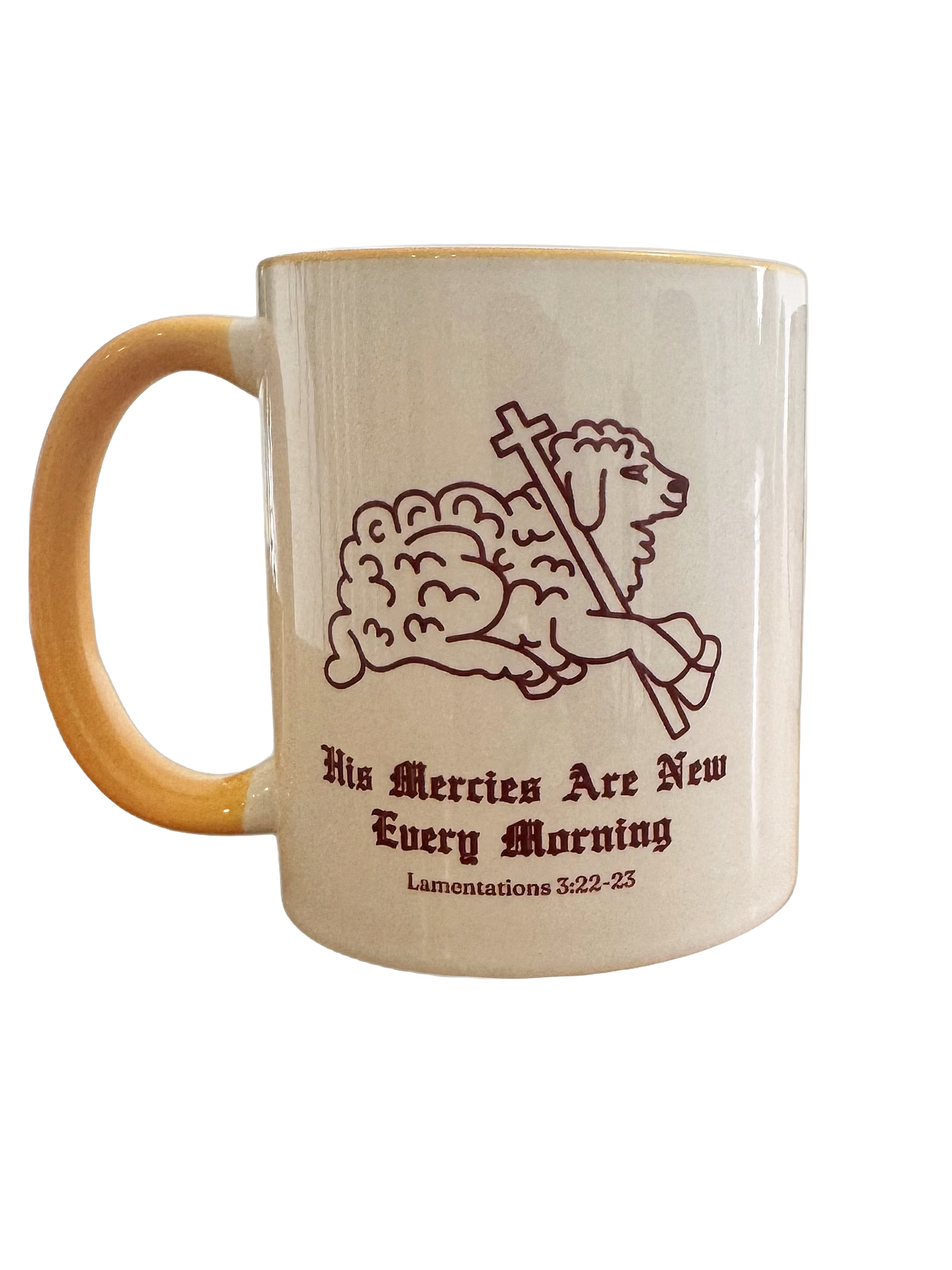
The Lamb dad cap carries the Lamb of God with the banner, embroidered, on an unstructured cap in black and gold or white and gold. The Morning Mercies mug has the same Lamb with Lamentations 3:22-23. It is the oldest image we make and the one we started with, because it is the title the Church gives Christ at the exact moment He is handed to you.


"Behold the Lamb of God, which taketh away the sin of the world."John 1:29